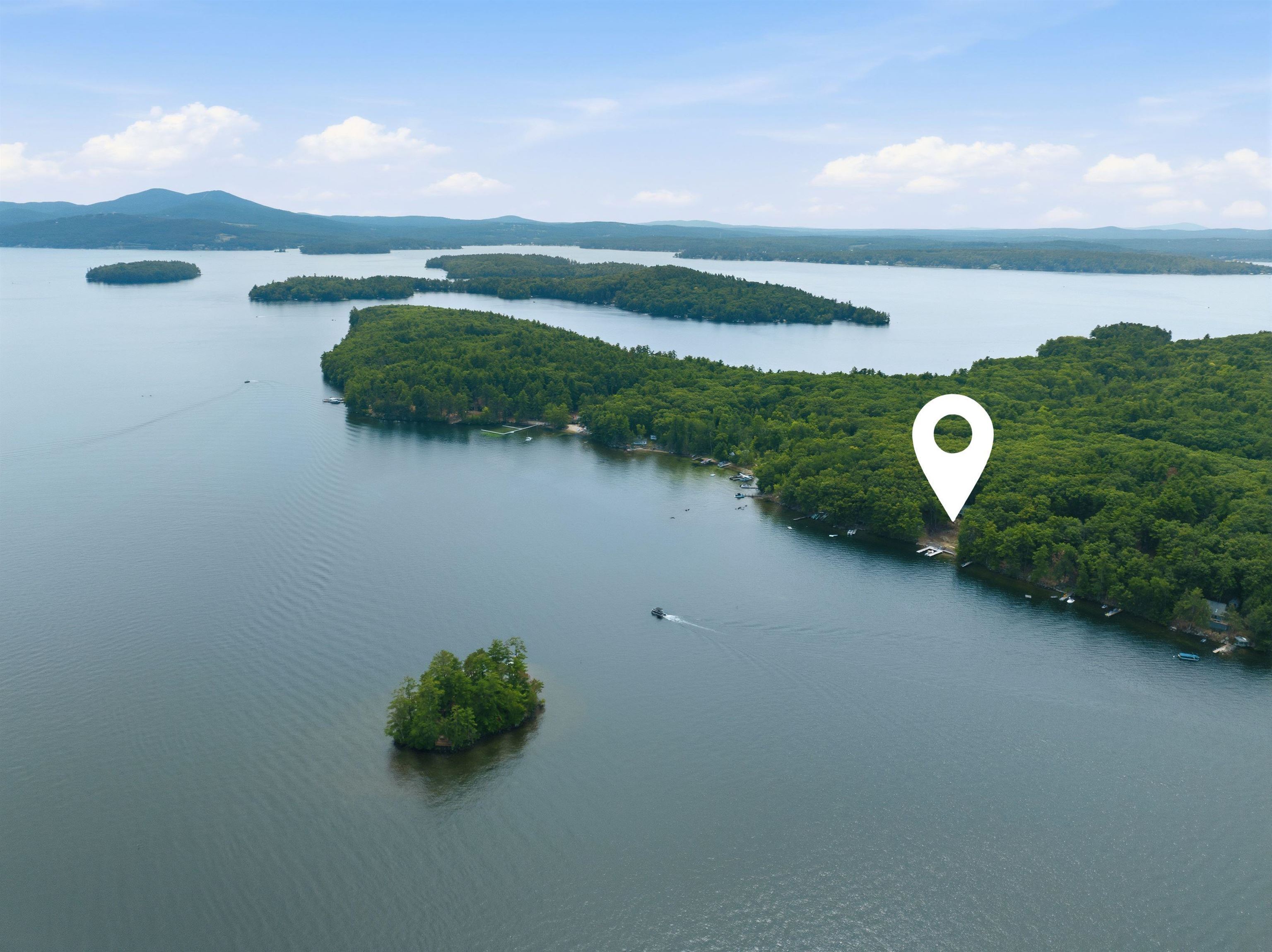
Triggs Island: The Hidden History of Lake Wentworth's Most Storied Isle
Triggs Island: The Hidden History of Lake Wentworth's Most Storied Isle
Most visitors to the Lakes Region know Lake Winnipesaukee by name, but tucked just to the east, in the town of Wolfeboro, lies Lake Wentworth, a quieter gem with a history all its own. And at the heart of that history sits Triggs Island, the lake's second-largest island, a place of colonial roots, Methodist ministers, eccentric community rules, and at least one future Supreme Court justice swimming hard toward the far shore.
The Man Behind the Name
The island takes its name from Thomas Triggs, one of Wolfeboro's earliest settlers. According to Benjamin Franklin Parker's 1901 History of Wolfeborough, Triggs arrived in the late 1760s or 1770s, farmed land in town, and for several years operated a local mill. He also owned what Parker specifically calls "Triggs's Island," identifying Thomas as the original proprietor.
What makes the family connection even more striking is how long it held. Parker noted in 1901 that the island had remained in the Triggs family for generations, passing down through successive members until the death of the last of them, which had occurred only "a few years" before his book went to press. For well over a century, one family's name and one family's land were essentially the same thing.
Parker described the island as lying north of Stamp Act Island and nearer the mainland, and estimated it at roughly 20 acres. (Later accounts give a smaller figure, possibly reflecting different measurement methods or shoreline definitions, so treat that number as approximate.)
Ministers, Rules, and a Very Methodist Island
After the last Triggs heir passed away, the island changed hands. A 1904 account describes the property moving to a buyer named Thomas W. Clow, who then sold it to a group of Methodist ministers. Whether that transaction sequence is perfectly precise is still worth verifying against deed records, but what happened next is well documented.
In 1905, the Triggs Island Association was formally organized. Its founding members were ministers, reportedly from Rhode Island, and the island quickly earned a second nickname: "Minister's Island." The early association built five cottages, arranged around the perimeter of the island while the interior was preserved as common land, available to all residents for things like cutting firewood (and, as later generations would learn, for producing a truly impressive crop of mosquitoes).
The association's early rules reflected its founders' sensibilities. No alcohol was permitted on the island. Deeds also included a right of first refusal, meaning that when a cottage came up for sale, fellow association members had the first opportunity to purchase it, an attempt to keep properties within the island community and its extended families.
Life on early Triggs was beautifully simple, and not always by choice. The first cottages had no electricity and no telephone service. Refrigeration came from iceboxes, stocked with blocks cut from Lake Wentworth each winter and stored for the summer season. As of the Wentworth Watershed Association's 2021 oral history gathering, some of those original iceboxes reportedly still survived in island cottages.
Before telephones, each family had its own car-horn code. Arrive at the mainland landing, honk your family's sequence (say, two shorts and a long), and someone on the island would recognize it and row over to collect you. When electricity and telephone service were eventually proposed, association members actually debated whether they wanted those modern intrusions at all. Electricity ultimately arrived via an underwater cable, making Triggs one of the few Lake Wentworth islands to have it.
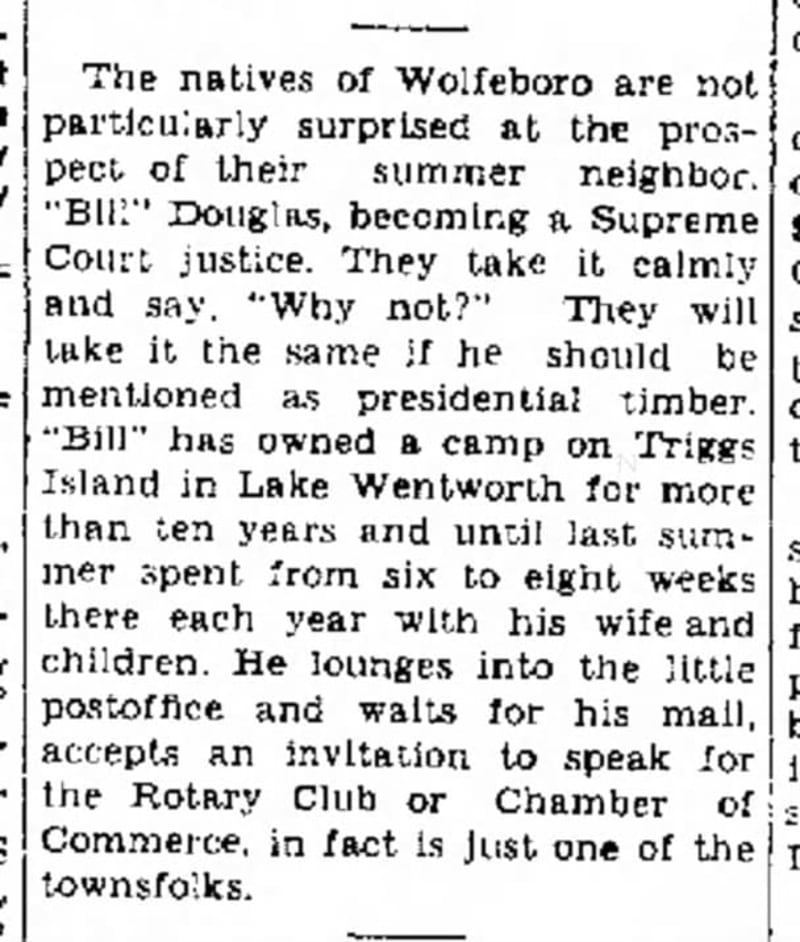
William O. Douglas and the Swim That Made History
By the 1930s, Triggs Island was a well-established summer colony drawing families from across New England. A 1931 Massachusetts newspaper, for instance, mentioned a family spending August at "Triggs Island, East Wolfeboro," in the casual way you'd mention a familiar destination.
But the island's most famous seasonal visitor was William O. Douglas, who would go on to become a U.S. Supreme Court justice in 1939, the same year the New Hampshire Historical Society recorded a newspaper article about him summering at Triggs. Douglas's personal papers at the Library of Congress (collection MSS18853) include a dedicated subject file labeled "Triggs Island, East Wolfeboro, N.H.," making clear that his connection to the island was substantial, not just a passing visit.
In his 1950 autobiography, Of Men and Mountains, Douglas wrote about Triggs in one of the book's most memorable passages. As a child, Douglas had nearly drowned and carried a deep fear of water for years. He described testing himself by diving from a dock on Triggs Island and swimming across Lake Wentworth to Stamp Act Island, a crossing he estimated at roughly two miles. He swam deliberately, switching strokes, and when he paused and looked down into the dark water beneath him, the old fear surfaced briefly. He kept going. The episode became central to his famous meditation on conquering fear.
There is also a tantalizing mystery tucked into those same Library of Congress archives. Box 634 of the Douglas papers contains a folder titled "Triggs Island litigation, 1927–1928," with a cross-reference to a separate Triggs Island file in Container 32. Douglas clearly considered this litigation significant enough to preserve carefully. What the dispute was about, whether it involved the right-of-first-refusal provisions in island deeds, a boundary question, or something else entirely, has not yet surfaced in searchable court records or newspaper archives. It may be the most interesting unanswered question in the island's history.
Summers, Waterskis, and Long Family Ties
Through the mid-century decades, island life settled into a warm and occasionally raucous rhythm. Families used the nearby Wentworth State Park beach for swimming. In the 1960s, waterskiing became a social centerpiece around Triggs, with longtime resident Steve Snow recalling groups burning through as much as 50 gallons of gasoline in a single weekend pulling skiers across the lake.
Island wildlife made its presence known, too. Residents have recalled watching a swimming deer get turned away from shore by a loon defending its chick, the bird flapping and lunging until the deer changed course and retreated.
Some families have kept their connection to Triggs for extraordinary spans of time. The Wentworth Watershed Association profiled Stephen Snow, who had spent nearly 75 summers on the island. His grandfather acquired the family's cottage during the Depression, and the property has stayed in the family ever since. That kind of multigenerational continuity, built on common land, shared rules, and the kind of community that honks a horn code instead of sending a text, is exactly what makes Triggs Island unlike almost anywhere else in New Hampshire.
A Short Drive from Everything We Love About the Lakes Region
Triggs Island sits within the town of Wolfeboro, one of the loveliest and most walkable communities on the eastern side of the Lakes Region. Whether you are drawn by the history, the quiet water, or simply the idea of a summer place with deep roots, this corner of New Hampshire rewards the curious traveler.
If a stay near Wolfeboro or Lake Wentworth sounds like your kind of vacation, we would love to help you find the right home base.
A Rare Chance to Own a Piece of That History
Triggs Island properties almost never come to market. The association's longtime right-of-first-refusal culture, combined with the fierce multigenerational loyalty that keeps cottages in families for 70 or 80 years at a stretch, means that listings here are genuinely uncommon events. Which is what makes the current offering so worth noting.
11 Triggs IslandSold
- Sold for: $725,000 (listed at $625,000)
- Beds: 4 | Baths: 1
- Square feet: 1,088
- Acreage: 1.06 acres
- Year built: 1906
- Waterfront: Lake Wentworth
Beyond the history, the setting speaks for itself. Situated on over an acre of Lake Wentworth waterfront, the cottage carries the same quiet, unhurried quality that drew Methodist ministers here more than a century ago, and that kept families like the Snows coming back for generation after generation. For the right buyer, this is less a real estate transaction and more an invitation into one of New Hampshire's most distinctive summer communities.

Frequently Asked Questions
Where exactly is Triggs Island located?
Triggs Island sits in Lake Wentworth, which lies just east of Lake Winnipesaukee in the town of Wolfeboro, New Hampshire. It is the second-largest island in Lake Wentworth, positioned north of Stamp Act Island and relatively close to the mainland shore.
Who was Thomas Triggs, and why is the island named after him?
Thomas Triggs was one of Wolfeboro's earliest settlers, arriving in the late 1760s or 1770s. He farmed land in town, operated a local mill for several years, and owned the island that came to bear his name. According to Benjamin Franklin Parker's 1901 history of Wolfeborough, the island remained in the Triggs family for generations, passing down until the last family member died just before the turn of the 20th century.
Why was Triggs Island called "Minister's Island"?
After the island left Triggs family ownership, it was eventually purchased by a group of Methodist ministers, reportedly from Rhode Island, who formed the Triggs Island Association in 1905. Because of that concentration of clergy among the early cottage owners, the island picked up the informal nickname "Minister's Island." The early association rules reflected that background, including a prohibition on alcohol.
What is the connection between Triggs Island and Supreme Court Justice William O. Douglas?
William O. Douglas summered on Triggs Island and wrote about it in his 1950 autobiography, Of Men and Mountains. He famously described swimming from a dock on Triggs across Lake Wentworth to Stamp Act Island, roughly two miles, as a way of confronting a fear of water rooted in a childhood near-drowning. His personal papers at the Library of Congress include a dedicated Triggs Island file, as well as a separate folder concerning "Triggs Island litigation, 1927–1928," the details of which remain historically unclear.
How often do properties on Triggs Island come up for sale?
Very rarely. The association's longstanding culture of keeping cottages within families, reinforced historically by right-of-first-refusal deed provisions, means that island properties can go decades without changing hands. The current listing at 11 Triggs Island, a four-bedroom cottage dating to 1906, represents the kind of opportunity that serious buyers in the Lakes Region may not see again for many years.
Can visitors access Triggs Island today?
Triggs Island is a private island with a long-established cottage association. It is not a public park or recreation area. The best way to appreciate it is by boat on Lake Wentworth, or by staying in Wolfeboro and exploring the surrounding area, including the nearby Wentworth State Park beach that island families have enjoyed for generations.
Curious about spending a week on Lake Winnipesaukee or exploring the Wolfeboro area yourself? Browse our vacation rentals →
Ready to explore what's available in the Lakes Region real estate market? View homes for sale →
Listing data provided by PrimeMLS for personal, non-commercial use. Data deemed reliable but not guaranteed. © 2026 PrimeMLS, Inc.
- 11 Triggs Island, Wolfeboro · Listed by Maxfield Real Estate/Wolfeboro · Jen McCullough
Listings Mentioned

IDX display courtesy of Yankee Pedlar Realtors, Wolfeboro NH.
PrimeMLS Listing Information displayed herein is deemed reliable but is not guaranteed accurate by PrimeMLS. This display of listings may or may not be the entire Compilation from the PrimeMLS database, and PrimeMLS does not guarantee the accuracy of such information. © PrimeMLS, Inc.
Listing brokers may report inaccurate data to michelle@yankeepedlarrealtors.com or call (603) 569-1000.
Properties You Might Love


On the Market

10 Pine Hill Road
Wolfeboro
Listing by KW Coastal and Lakes & Mountains Realty/Wolfeboro · Joshua Johnson

65 Trotting Track Road
Wolfeboro
Listing by Maxfield Real Estate/Wolfeboro · Jake Froehlich

65 Trotting Track Road
Wolfeboro
Listing by Maxfield Real Estate/Wolfeboro · Jake Froehlich

21 Waumbeck Road
Wolfeboro
Listing by KW Coastal and Lakes & Mountains Realty · Purple Acorn Acorn
IDX display courtesy of Yankee Pedlar Realtors, Wolfeboro NH.
PrimeMLS Listing Information displayed herein is deemed reliable but is not guaranteed accurate by PrimeMLS. This display of listings may or may not be the entire Compilation from the PrimeMLS database, and PrimeMLS does not guarantee the accuracy of such information. © PrimeMLS, Inc.
Listing brokers may report inaccurate data to michelle@yankeepedlarrealtors.com or call (603) 569-1000.